
Evaluating whether a tennis racket supports your development requires looking beyond marketing claims to understand how physical specifications translate to on-court performance. For the Wilson Tour Premier, the core decision hinges on how its weight, head size, balance, and stiffness interact with your physical strength and developing stroke mechanics. Choosing a racket with the wrong specifications can hinder your progress, lead to poor habits, or even cause physical discomfort.
By learning to decode the technical details printed directly on the frame, you can determine if this racket aligns with your current physical capabilities. This guide breaks down the essential specifications you need to verify and explains what they mean for your comfort, forgiveness, and skill progression on the court.
Identifying the Core Specs of the Wilson Tour Premier
Before making a decision, you must locate the technical specifications of the specific racket model you are holding. Manufacturers typically print these details directly on the inside of the racket throat or along the shaft. Because different production runs or regional editions of the Wilson Tour Premier can feature slight variations, verifying the physical label is always more reliable than relying on general online descriptions.
Products mentioned in this guide
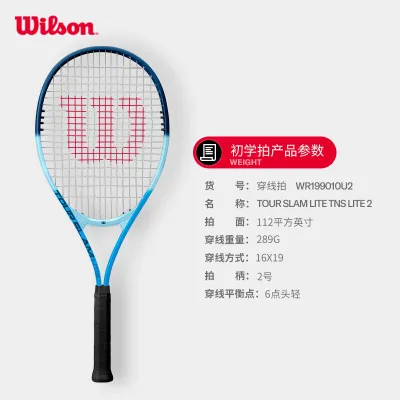
Prices are valid at publication and may change. Please refer to the product page for the latest price.
First, look for the head size, which is usually measured in square inches or square centimeters. Next, locate the weight, which is typically listed as unstrung weight in grams. You will also find the balance point, often indicated in millimeters or as a specific number of points “head-light” or “head-heavy.”
Additionally, check the string pattern, which is represented by two numbers, such as 16×19 or 18×20. The first number indicates the number of main (vertical) strings, while the second represents the cross (horizontal) strings. A 16×19 pattern is considered relatively open, which generally provides a softer feel and easier access to spin—both of which are highly beneficial when you are learning to control the ball.
Finally, identify the grip size, which is usually marked on the butt cap or the lower handle. Grip sizes typically range from 0 to 5 (or L0 to L5 in European sizing). Selecting the correct grip size is crucial for maintaining proper wrist alignment and preventing the racket from twisting in your hand during impact.
Translating Head Size and Weight for Beginner Play
Once you have located the numbers on the frame, you need to translate them into how the racket will actually feel during a rally. The head size of the racket directly dictates the size of the sweet spot, which is the area of the string bed that provides the most predictable power and comfort. For beginners, a larger head size—typically 100 square inches or larger—is highly recommended because it offers greater forgiveness on off-center hits, helping you keep the ball in play even when your timing is slightly off.

Weight is another critical factor that influences both swing speed and physical fatigue. Rackets designed for recreational or beginner play generally feature an unstrung weight between 260 and 285 grams. A lighter frame is much easier to swing, allowing you to focus on learning the correct path of a forehand or backhand without straining your shoulder or wrist.
However, there is a distinct trade-off when it comes to racket weight. While a lighter racket is highly maneuverable, it can feel unstable or push back against you when you try to return a fast, heavy ball. Conversely, a heavier racket provides more stability and plow-through power, but it requires established technique and physical strength to swing consistently over a long session.
For most beginners, prioritizing maneuverability over raw stability is the safest path. You should verify that the racket’s weight allows you to complete a full, relaxed swing from start to finish without feeling like you have to muscle the frame through the air.
How Balance and Stiffness Impact Skill Development
Beyond weight and head size, how that weight is distributed across the frame—known as the balance—profoundly affects how heavy the racket feels once it is in motion. A head-heavy racket concentrates more mass toward the top of the hoop, which helps generate natural power and depth from the baseline even with slower swing speeds. However, this distribution can make the racket feel sluggish when you need to react quickly, such as during volleys at the net.
In contrast, a head-light racket places more weight in the handle. This design increases maneuverability, making it easier to position the racket quickly, but it requires you to generate more of your own swing speed to send the ball deep into the opponent’s court. Beginners often benefit from a neutral or slightly head-light balance, which offers a balanced compromise between easy handling and adequate power.
Frame stiffness, often omitted from basic labels but critical to performance, determines how much the racket bends when it contacts the ball. A stiff frame bends very little, transferring more energy back into the ball for easy power, but it also transmits more harsh vibrations directly to your hand and arm. A more flexible frame absorbs more of the impact energy, offering a softer feel and better control, though it requires a more developed swing to generate depth.
For a developing player, physical comfort and consistent sensory feedback are essential. If a racket is too stiff, the resulting vibrations can mask the subtle physical cues that tell you whether you hit the sweet spot, while also increasing the risk of joint fatigue. Opting for a frame with moderate flexibility helps protect your arm as you build muscle memory.
Deciding if the Spec Profile Matches Your Needs
To determine if the Wilson Tour Premier is the right fit for your current skill level, you should perform a few physical checks before hitting the court. Start by holding the racket at the very bottom of the handle using your natural grip. There should be roughly a finger’s width of space between your fingertips and your palm; if your fingers wrap all the way around and press into your palm, the grip is too small.
In warm, humid climates, sweat can quickly compromise your hold on the handle. If you find yourself squeezing the racket tightly just to keep it from slipping, apply a high-traction overgrip to absorb moisture and improve security without significantly increasing the grip size.
Next, perform a few slow shadow swings in a safe space. Pay close attention to your wrist and shoulder. If the racket feels like it is dragging your wrist down at the end of the swing, or if you feel a sudden strain when trying to stop the motion, the swing weight may be too high for your current physical strength.
If you already own the racket and find it slightly too stiff or unforgiving, you can adjust its playability through your string setup. Avoid stiff polyester strings, which are designed for advanced players who swing with high speed and heavy spin. Instead, string the racket with a soft multifilament or synthetic gut string, and request a lower tension—such as 50 pounds (approximately 22.7 kilograms). This adjustment increases the trampoline effect of the string bed, providing easier depth and absorbing more impact shock.
Always remember that equipment cannot replace proper coaching and physical conditioning. If you experience persistent pain in your elbow, wrist, or shoulder during or after play, stop using the racket immediately and consult a qualified tennis professional or coach to evaluate your technique and equipment setup.
Frequently Asked Questions (FAQ)
Is the Wilson Tour Premier generally classified as a beginner or advanced racket?
The Wilson Tour Premier line is generally designed to cater to recreational, beginner, and intermediate players. Its design philosophy typically emphasizes a balance of maneuverability, moderate power, and a forgiving sweet spot. However, because specifications can vary across different model years and specific sub-editions, you should always verify the exact weight and head size printed on the frame rather than relying solely on the model name.
How can a beginner adjust the string setup to make this racket more forgiving?
To make the racket more forgiving, you should avoid stiff polyester strings and instead choose a soft multifilament or synthetic gut string. Additionally, ask your stringer to tension the racket at the lower end of the manufacturer’s recommended range. A lower tension creates a softer string bed that absorbs more vibration, increases comfort, and helps you generate depth with less physical effort.

Community discussion
Share your experience or ask a question. Comments are reviewed before publication.