
Selecting the right resistance band for leg workouts in Singapore requires balancing material durability, resistance levels, and the specific exercises you plan to perform. With the tropical humidity accelerating the wear of rubber and latex, local fitness enthusiasts must look beyond basic aesthetics to find bands that maintain their elasticity and grip during intense lower-body sessions. Whether you are targeting your glutes with lateral walks or building quad strength with assisted squats, the ideal band must match your physical capacity and the biomechanical demands of your training environment.
To make an informed decision, you must evaluate the structural differences between fabric and latex loops, understand how tension ratings translate to real-world muscle activation, and know how to inspect safety features before every workout. This guide provides a systematic framework to help you choose, verify, and maintain the best lower-body resistance bands for your home gym or outdoor workouts.
Understanding Resistance Band Types for Leg Training
To build an effective lower-body routine, you must first understand that different band designs serve distinct biomechanical purposes. Leg exercises involve some of the largest and most powerful muscle groups in the body, such as the gluteus maximus, quadriceps, and hamstrings, alongside smaller stabilizing muscles like the gluteus medius and hip rotators. Matching the band type to the movement pattern ensures optimal tension throughout the entire range of motion.
Products mentioned in this guide
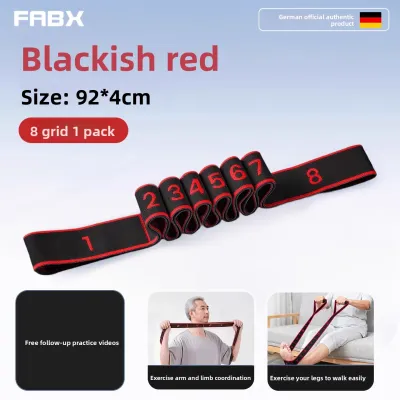
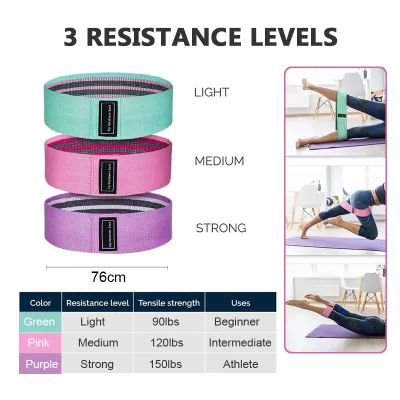
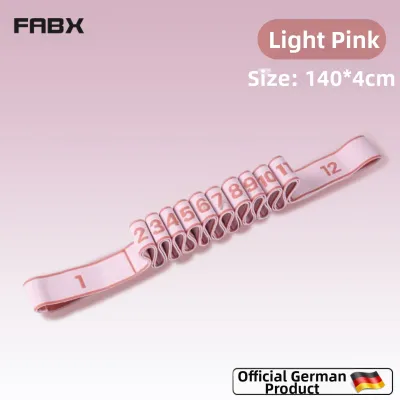
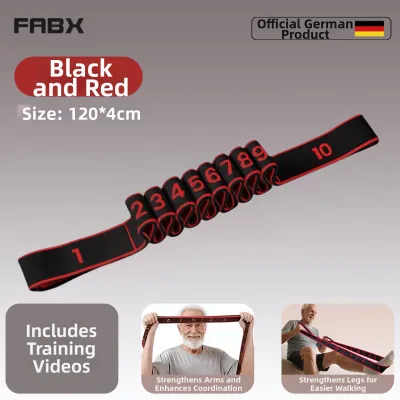
Prices are valid at publication and may change. Please refer to the product page for the latest price.
Loop bands, which are continuous circular bands, are the most common choice for lower-body training. They are generally divided into mini loops (typically 12 inches long) and long loops (41 inches long). Mini loops are exceptionally effective for closed-chain exercises where your feet remain in contact with the floor or a stable surface. Placing a mini loop around your thighs or ankles during glute bridges, lateral monster walks, and air squats forces your hip abductors to fire continuously to prevent your knees from collapsing inward.
Long loops, on the other hand, are highly versatile for adding resistance to compound movements. By stepping on one end of a long loop and looping the other over your shoulders, you can simulate a barbell squat or good morning, loading the posterior chain without heavy iron plates. This makes them an excellent option for home workouts where space for bulky weight plates is limited.
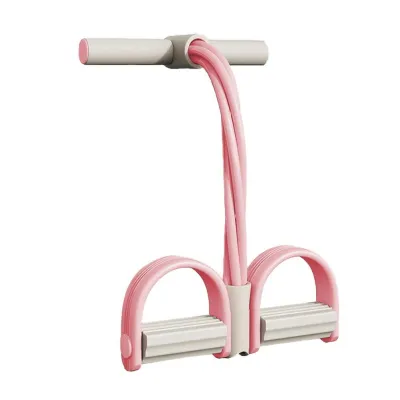
Tube bands with handles offer a different resistance profile, making them highly suitable for open-chain leg exercises where one foot moves freely through space. These bands consist of hollow latex tubes with carabiners at each end that clip onto foam handles, ankle straps, or door anchors. For leg extensions, hamstring curls, and standing kickbacks, tube bands allow you to anchor the resistance to a low point and isolate specific muscle groups. The ankle strap attachment provides a secure connection that prevents the band from slipping off your foot mid-rep.
Figure-8 bands feature two loops connected in the center, often by a plastic or rubber sleeve, forming an ‘8’ shape. While less common than standard loops, they are highly effective for targeted hip abductor and adductor movements. By placing your feet or ankles into the two separate loops, you get a pre-set width that provides immediate, high-tension resistance over short ranges of motion. This makes them excellent for quick warm-ups, physical therapy exercises, or isolating the outer hips without the band sliding up or down your legs.
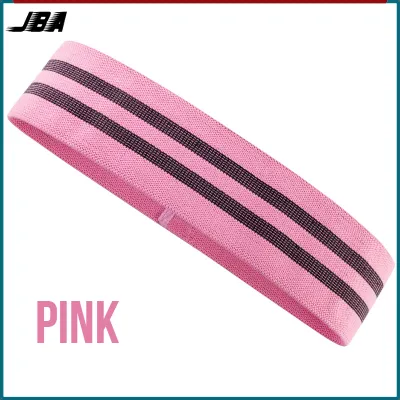
When choosing between these types, the material composition—primarily fabric versus latex or rubber—presents a major trade-off. Fabric bands, usually woven from a blend of polyester and elastic latex threads, are wide, thick, and highly resistant to rolling or sliding. They provide high, consistent tension over a limited range of stretch, making them the gold standard for glute-focused mini-loop exercises. However, their lack of extreme stretch limits their versatility for full-body movements.
Pure latex or rubber bands offer superior elasticity, stretching up to three or four times their original length. This makes them highly versatile for long-loop exercises and deep squats, but they are prone to rolling up, pinching the skin, and degrading faster when exposed to sweat and heat. Understanding these material differences allows you to select the right tool for your specific training goals.
How to Select the Right Resistance Level for Your Goals
Selecting the appropriate tension level is critical to ensuring your leg workouts are both challenging and safe. Unlike free weights, where a ten-kilogram dumbbell always weighs ten kilograms, resistance bands operate on a variable tension curve. The resistance increases progressively as the band is stretched, meaning the load is lightest at the start of the movement and heaviest at the peak contraction.

When evaluating bands, you will often encounter manufacturer tension charts that list resistance in weight equivalents, such as “10 to 15 kilograms.” It is vital to understand that these numbers represent the tension at maximum safe elongation, not the starting resistance. For leg workouts, where the range of motion can vary significantly between a short-range lateral walk and a deep squat, you cannot rely solely on these nominal poundage ratings. Instead, use them as a relative guide to compare levels within the same brand.
Your choice of resistance must also account for the size and strength of the target muscle groups. Large, powerful muscles like the quadriceps and glutes require substantial resistance to stimulate hypertrophy or strength endurance. For compound movements like squats or deadlifts, you will generally need heavy or extra-heavy bands to feel adequate tension. Conversely, smaller stabilizing muscles, such as the hip abductors targeted during lateral walks or clamshells, fatigue quickly and require light to medium resistance.
Using a band that is too heavy for stabilizers forces larger prime movers to take over, defeating the purpose of the isolation exercise and potentially straining your joints. This compensation pattern can lead to poor movement mechanics and reduced training efficiency over time. Therefore, matching the tension to the specific muscle group is just as important as matching it to your overall fitness level.
Because of these varying requirements, purchasing a multi-pack or a graduated set of bands is highly recommended over buying a single band. A complete set allows you to implement progressive overload—the gradual increase of stress placed upon the body during training. As your legs grow stronger, you can transition to the next tension level or combine multiple bands to increase the load. Furthermore, a set ensures you have the correct resistance on hand for different exercises within the same workout, allowing you to seamlessly transition from heavy squats to lighter hip mobility work.
Key Quality and Durability Checks Before You Buy
Given the high forces applied during lower-body training, verifying the build quality of your resistance bands is essential to prevent sudden snaps and ensure long-term durability. A band failure during a heavy squat or kickback can lead to painful snap-back injuries or loss of balance. Taking a few moments to inspect key structural components before making a purchase can save you from future frustration.
For fabric loop bands, the primary areas to inspect are the seam strength and edge stitching. High-quality fabric bands feature reinforced, multi-row stitching at the joint where the loop is closed. Look for double or triple-stitched seams with heavy-duty nylon thread, as weak seams will quickly fray and unravel under the high tension of leg presses or squats. Additionally, examine the edges of the band; they should be bound or tightly woven to prevent the elastic fibers inside from pulling away from the polyester sheath.
When evaluating tube bands, the critical failure points are the attachment interfaces. Inspect the carabiners, clipping mechanisms, and the internal anchoring system of the tubes. The carabiners should be made of solid steel or high-strength aluminum, with smooth gates that close securely. Avoid thin, wire-gate clips that can bend under load. The connection between the latex tube and the metal ring must be reinforced, typically with a protective fabric sleeve or a heavy-duty plastic plug inside the tube, to distribute the tension and prevent the rubber from tearing at the joint.
For fabric loops, anti-slip features are non-negotiable for comfort and performance. High-quality fabric bands incorporate inner silicone strips or rubberized grippers woven directly into the interior surface. These grippers create friction against your workout leggings or bare skin, preventing the band from rolling into a tight, painful cord or sliding down your thighs mid-set. Before purchasing, verify that the silicone lining is wide, continuous, and securely bonded to the fabric, as thin or patchy silicone strips tend to peel off after a few washes.
Finally, always review the product labels and specifications for material composition and maximum stretch limits. Pure natural latex is generally more durable and retains its elasticity longer than synthetic TPE (thermoplastic elastomer) rubber, which tends to stretch out permanently over time. Ensure the manufacturer explicitly states the maximum safe stretch limit, which is usually expressed as a multiple of the resting length. Operating within these limits is key to preventing structural failure.
Building Your Leg Workout Band Shortlist
When shopping for resistance bands in Singapore, navigating the vast array of options on e-commerce platforms and local sports retailers requires a structured filtering process. Rather than choosing the cheapest option or the one with the most colorful packaging, you should systematically narrow down your choices based on functional criteria. Setting a realistic budget, such as S$20 to S$50 for a high-quality multi-pack, is a sensible starting point.
Begin by using search filters on online marketplaces to isolate bands by material type and resistance range. Pay close attention to verified user reviews, specifically filtering for feedback that mentions “legs,” “squats,” or “glutes.” Look for reviews that discuss how the bands perform under heavy tension, whether the fabric stretches out permanently after a few weeks, and if the silicone grips actually prevent slipping on different types of activewear. User photos and videos can provide valuable clues about the actual thickness and width of the bands compared to the promotional images.
Next, compare the warranty terms and return policies offered by different fitness brands and retailers. While resistance bands are generally considered consumable fitness accessories, reputable manufacturers often provide a limited warranty against manufacturing defects, such as premature snapping or seam unraveling. A brand that stands behind its product with a clear replacement policy offers peace of mind, especially if you plan to use the bands for high-frequency, heavy strength training.
Verifying seller authenticity is another crucial step when purchasing from online marketplaces. The market is flooded with counterfeit or substandard rubber bands that mimic the appearance of premium brands but use cheap, synthetic fillers. These low-grade materials degrade rapidly in Singapore’s warm, humid climate, leading to micro-cracks and sudden snapping. To protect yourself, purchase directly from official brand stores, authorized local distributors, or well-established local sports retailers. Check the seller’s rating, response rate, and history to ensure you are receiving genuine, safety-tested equipment.
Safety and Maintenance Tips for Long-Lasting Use
Proper care and regular safety inspections are vital to maximizing the lifespan of your resistance bands and preventing training accidents. Because elastic materials are subject to wear and environmental degradation, establishing a simple maintenance routine will keep your equipment performing safely for years. This is especially true for bands used in tropical environments where heat and humidity accelerate material breakdown.
Before every single workout, perform a quick visual and tactile inspection of your bands. For latex and rubber bands, stretch them slightly and look for micro-tears, small nicks, thinning sections, or areas of discoloration. Run your fingers along the edges to feel for any rough spots or cracks. For fabric bands, check for loose threads, fraying seams, or loss of elasticity. If you detect any structural compromise, no matter how small, discard the band immediately. A tiny micro-tear can rapidly expand under tension, resulting in a sudden, high-velocity snap.
When performing exercises that require anchoring, such as leg curls or kickbacks, always use proper anchoring techniques. Never anchor a band around sharp edges, rough concrete, or abrasive metal surfaces, as the friction will quickly cut through the material. Use a dedicated door anchor with a soft, padded stop, and ensure you slide the anchor over the hinge side of a door that closes toward you. This ensures the door frame supports the force of your pull, rather than relying solely on the latch mechanism.
Sweat, body oils, and outdoor dirt can degrade both fabric and rubber over time. After a sweaty leg session, clean your bands according to the manufacturer’s instructions. For latex bands, wipe them down with a damp cloth and mild soap, then let them air dry completely. Avoid harsh chemical cleaners or alcohol-based sanitizers, which dry out the rubber. Fabric bands can usually be hand-washed in cold water with a mild detergent and air-dried. Never put resistance bands in a clothes dryer, as the high heat will destroy the elastic fibers.
Finally, storage conditions play a massive role in preserving elasticity. Store your bands in a cool, dry place away from direct sunlight, moisture, and extreme heat. Ultraviolet rays and high temperatures accelerate the oxidation of natural latex, causing it to become brittle, sticky, or prone to snapping. Avoid leaving your bands in a hot car, on a sunny balcony, or stuffed damp into a gym bag. Storing them loosely coiled in a breathable mesh bag will keep them in peak condition for your next lower-body workout.
Frequently Asked Questions (FAQ)
Can resistance bands replace weights for building leg muscle?
Resistance bands can effectively stimulate muscle growth, but they operate differently than free weights. Bands provide accommodating resistance, meaning the tension increases as the band stretches, which highly activates muscles at the peak of contraction. This is excellent for targeting the glutes and stabilizers. However, because bands lack the constant gravitational load of barbells or dumbbells—especially during the eccentric lowering phase of a lift—they are less efficient for building maximum absolute strength. For optimal leg development, use bands as a portable solution, for high-volume metabolic stress, or as a complement to traditional free weights.
Why do my fabric resistance bands keep rolling up during squats?
Fabric bands typically roll up due to incorrect sizing, poor placement, or low-friction clothing. If a band is too tight for your thigh circumference, the excessive tension will force the edges to curl inward, initiating a roll. To prevent this, place the band at least two to three inches above your knee joint, rather than directly on it or too high up the hip. Additionally, wearing slick, high-gloss polyester leggings reduces friction, making it easier for the band to slide. Opt for matte-finish compression tights or textured fabrics, and ensure your bands feature wide, continuous internal silicone gripping strips to lock them securely in place.

Community discussion
Share your experience or ask a question. Comments are reviewed before publication.