
Deciding whether to upgrade your existing 20-inch mountain bike (MTB) or purchase a brand-new model often comes down to a balance of frame condition, component compatibility, and the rider’s physical growth. If the frame is structurally sound and only needs minor, high-impact contact point adjustments, upgrading is a highly cost-effective way to extend the bike’s life. However, if you are facing major drivetrain, suspension, or braking overhauls on an aging frame, buying a new bike is almost always the smarter financial and safety decision. Understanding where your current ride sits on this spectrum will save you from sinking money into a platform that may soon be outgrown or remains fundamentally limited by outdated standards.
How Can You Tell If Your 20-Inch MTB Frame Is Worth Saving?
You can determine if your 20-inch MTB frame is worth saving by conducting a rigorous physical inspection for structural cracks, deep rust, and alignment issues. If the frame exhibits any signs of metal fatigue, compromised welds, or severe corrosion, it is unsafe to ride and should be retired rather than upgraded.
A thorough inspection begins with stripping away dirt and grime to expose the bare frame, focusing closely on the welded joints around the head tube, bottom bracket shell, and rear dropouts. These areas experience the highest stress during trail riding and are the most common sites for hairline fractures or paint spidering, which often indicates underlying metal fatigue. Aluminum frames do not rust, but they are susceptible to stress cracking over years of hard use, whereas steel frames can suffer from internal rust that weakens the tubing from the inside out.
Products mentioned in this guide
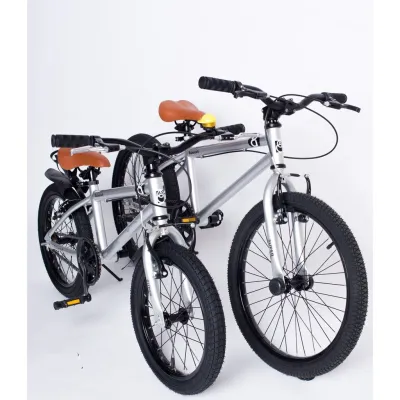
6 Lazada user ratings
Nice bike. Faster delivery. Seller accommodated our requests for delivery. Have give few goodies too.
Beautiful, sturdy bicycle. Seller is very helpful and responsive. Highly recommended!
Excellent service from the seller, excellent product and fast delivery.
Bike is good for my grand daughter. Very sturdy, quality looks good
Prices are valid at publication and may change. Please refer to the product page for the latest price.
Next, examine the threaded interfaces and bearing seats of the frame. Inspect the bottom bracket shell for stripped threads or ovalization, which can prevent a new bottom bracket from seating securely and lead to persistent creaking or play. Similarly, check the head tube to ensure it remains perfectly round; a distorted head tube will cause headset bearings to wear prematurely and compromise steering safety.
Finally, evaluate the rear dropouts where the wheel axle mounts. If the dropouts are bent, cracked, or severely gouged from loose axles, securing the rear wheel safely becomes difficult, leading to alignment issues that affect both braking and shifting. If any of these structural areas show signs of compromise, the frame is no longer a viable foundation, and any further investment in upgrades is both financially impractical and safety-deficient.
Which Component Upgrades Deliver the Best Value for a 20-Inch MTB?
The component upgrades that deliver the best value for a 20-inch MTB are high-impact contact points like tires, grips, and pedals, which immediately improve control and comfort for a relatively low cost. Upgrading complex systems like suspension forks or multi-speed drivetrains on a 20-inch platform rarely yields a justifiable return on investment due to high parts costs and limited performance gains.

Tires are the single most influential upgrade you can make on a smaller-wheel mountain bike. Replacing heavy, rigid stock tires with high-quality, folding-bead tires featuring a trail-appropriate tread pattern and a compliant casing dramatically improves traction, cornering confidence, and ride quality. Pair these with lightweight inner tubes or a tubeless setup if the rims allow, as reducing rotational weight on a 20-inch wheel makes the bike feel significantly more agile and easier to accelerate.
Contact points like handlebar grips and pedals represent another high-value, low-cost upgrade area. Stock plastic pedals offer very little traction, especially in wet conditions, so swapping them for slim composite platform pedals with metal pins provides a secure interface that keeps feet planted on rough terrain. Ergonomic or soft-compound lock-on grips also reduce hand fatigue and prevent the grips from twisting on the handlebar during active steering maneuvers.
When it comes to stopping power, upgrading basic mechanical rim brakes or low-end mechanical disc brakes to reliable hydraulic disc brakes can transform the riding experience, provided the frame and fork have the correct mounting tabs. However, upgrading the drivetrain or suspension fork on a 20-inch bike requires caution. High-quality 20-inch air suspension forks are rare and expensive, and upgrading a basic freewheel drivetrain to a modern wide-range cassette system often requires replacing the entire rear wheel, making the total cost disproportionately high for this wheel size.
At What Point Do Upgrade Costs Outweigh Buying a New Bike in Singapore?
Upgrade costs outweigh buying a new bike in Singapore when the cumulative price of replacement parts and professional workshop labor exceeds S$250 to S$300, which is roughly half the cost of a high-quality new 20-inch youth MTB. If your current bike requires multiple major component replacements simultaneously, purchasing a new, fully assembled bike is almost always the more economical path.
To evaluate the financial feasibility, consider the typical retail prices of individual components alongside professional labor rates at local bicycle workshops in Singapore. A decent pair of 20-inch trail tires can cost between S$60 and S$100, while a basic hydraulic brake set might run from S$80 to S$120. If you also need to replace a worn drivetrain, a new chain, cassette, and shifter can easily add another S$80 to S$150 to your parts bill.
Labor costs in Singapore workshops must also be factored into your calculations if you do not plan to perform the installations yourself. Standard workshop fees for installing a drivetrain, bleeding hydraulic brakes, or replacing a bottom bracket typically range from S$30 to S$80 per service. When you combine these labor charges with the cost of the parts, a comprehensive overhaul can quickly climb past S$350, approaching or exceeding the price of a brand-new, well-equipped youth mountain bike.
Furthermore, if the rider is a growing child, investing heavily in a 20-inch frame is a short-term solution, as they will soon transition to a 24-inch or 26-inch bike. A new entry-level youth mountain bike from a reputable brand offers updated geometry, modern standards, and a full manufacturer warranty, making it a far more sensible allocation of your budget than trying to modernize an older, heavily worn 20-inch platform.
What Compatibility Issues Should You Expect When Upgrading Older 20-Inch Bikes?
When upgrading older 20-inch mountain bikes, you should expect significant compatibility bottlenecks due to outdated axle standards, narrow bottom bracket shells, and straight steerer tubes. These legacy specifications make finding high-performance modern replacement parts extremely difficult and often require custom modifications that compromise safety.
One of the most common compatibility hurdles is the steering system, where older or entry-level 20-inch frames often use a 1-inch or 1-1/8-inch straight steerer tube. Most modern, high-performance suspension forks are designed for tapered steerer tubes, making them physically incompatible with older frames. Finding a quality air-sprung suspension fork with a straight steerer and a 20-inch wheel size is exceptionally difficult, often forcing you to choose between heavy, low-performing coil forks or expensive specialty components.
Axle and brake mounting standards present additional challenges. Older frames typically rely on open dropouts with quick-release or bolt-on axles, whereas modern high-end wheelsets utilize thru-axle designs for increased stiffness. Additionally, if your current frame is designed exclusively for rim brakes (such as V-brakes), you cannot upgrade to disc brakes without replacing both the frame and the fork, as there are no safe aftermarket adapters to mount disc calipers onto a non-disc frame.
Bottom bracket standards also vary widely, with older steel frames often utilizing threaded American (one-piece crank) bottom brackets rather than modern English-threaded (BSA) or press-fit standards. Converting these older bottom bracket shells to accept modern multi-piece cranksets requires specialized adapters that can be difficult to source and install correctly. If you encounter multiple conflicting standards during your planning phase, it is highly recommended to stop and consult a professional bicycle mechanic at a local shop to avoid purchasing incompatible parts.
How Do Your Future Riding Goals Dictate the Upgrade or Replace Decision?
Your future riding goals dictate the upgrade or replace decision by highlighting whether the current 20-inch frame geometry can safely support the rider’s advancing skill level and terrain choices. If the goal is to progress to technical singletrack trails and bike parks, transitioning to a modern bike with progressive geometry is far safer and more effective than upgrading an older, recreational-grade frame.
For casual riding on paved park connectors, flat gravel paths, or mild green trails, a basic 20-inch mountain bike is perfectly adequate. In this scenario, minor maintenance and low-cost upgrades like fresh tires and comfortable grips are all that is needed to keep the bike running smoothly. There is no need to invest in expensive high-performance components or a new bike if the current platform safely meets these simple recreational needs.
However, if the rider is developing a passion for aggressive trail riding, jumps, and technical descents, the limitations of older 20-inch geometry become a safety concern. Older frames often feature steep head tube angles and short wheelbases, which can make the bike feel unstable and prone to sending the rider over the handlebars on steep drops. Modern youth mountain bikes are engineered with slacker head angles, longer reach, and wider handlebars, providing the stability and control necessary for high-speed trail riding.
Ultimately, the decision should be guided by a clear assessment of the bike’s current state and the rider’s physical growth. If the rider is within a year of outgrowing the 20-inch wheel size entirely, the most sensible approach is to perform only essential safety maintenance on the current bike and save your budget for a properly fitted 24-inch or 26-inch mountain bike when the time comes. This ensures your investment goes toward a platform that will support their riding progression and physical development for several years to come.

Community discussion
Share your experience or ask a question. Comments are reviewed before publication.