
Combining a Reebok deck with a foam roller elevates your post-run recovery by using height, angles, and stable leverage to target deep muscle tension. Running on hard concrete paths or park connectors puts immense stress on your lower body. By using the adjustable height of the Reebok deck alongside a standard foam roller, you can modify your body weight distribution, access hard-to-reach angles in your calves, quads, and glutes, and perform anchored stretches that are difficult to execute on a flat floor alone. This combination allows you to control the pressure of your self-myofascial release more precisely, helping to alleviate post-run stiffness and restore mobility.
Setting Up Your Reebok Deck and Foam Roller Safely
Safety is paramount when transitioning your body weight onto elevated fitness equipment after an exhausting run. Before starting your recovery session, place your Reebok deck on a flat, non-slip surface. If you are training at home on smooth tile or laminate flooring, use a high-grip yoga mat or rubber gym tiles underneath the deck to prevent it from sliding during dynamic movements.
Next, verify that the deck’s risers are fully locked into the base. The click-and-lock mechanism must be completely engaged on both sides; an unsecured riser can collapse under lateral pressure, leading to sudden falls or joint strain.
Products mentioned in this guide
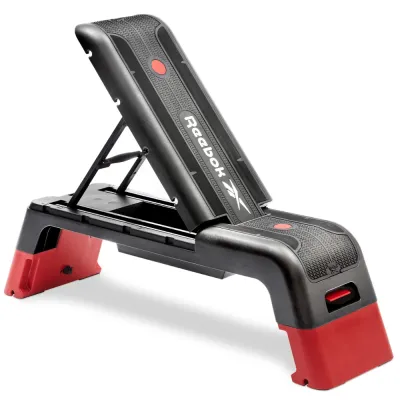
Prices are valid at publication and may change. Please refer to the product page for the latest price.
Inspect your foam roller before placing it on or near the deck. Look for deep gouges, cracks, or structural degradation. A roller that has lost its structural integrity can compress unevenly, causing sudden shifts in your body weight or even pinching your skin.
Establish clear stop conditions for your session. Self-myofascial release should feel like a deep, dull ache or a release of muscle tension. If you experience sharp joint pain, nerve tingling, numbness, or notice immediate bruising, stop the exercise immediately. These sensations indicate pressure on nerves, ligaments, or blood vessels rather than muscle tissue.
Finally, keep a stable support nearby, such as a sturdy wall, a heavy sofa, or a secure chair. Transitioning between elevated positions on the deck and grounded positions on the floor requires balance, which can be compromised when your muscles are fatigued from a long run.
Core Techniques for Combining the Deck and Roller
Combining an adjustable step deck with a foam roller introduces unique mechanical advantages that floor-only rolling cannot match. By elevating your limbs or torso, you alter the angle of pull on your muscles and tendons. This elevation allows gravity to assist in applying deeper, more consistent pressure to target tissues without requiring you to support your entire body weight with your upper body.

To maximize these benefits, maintain active core engagement and practice slow, controlled diaphragmatic breathing. Tensing up or holding your breath in response to discomfort triggers a protective muscle guarding reflex, which prevents the roller from penetrating into the deeper fascial layers.
Elevating Limbs for Deeper Roller Access
Elevating your non-working limbs or torso on the Reebok deck changes how your body weight is distributed over the foam roller. On a flat floor, supporting your body during rolling often requires significant shoulder and core strength, which can lead to premature fatigue before your muscles have fully relaxed. By resting your hips, back, or opposite leg on the elevated deck, you can isolate the target muscle and apply precise, controlled pressure.
Before applying weight, perform a quick stability check. Ensure your elevated foot or hand is centered on the textured, high-traction surface of the deck. This rubberized surface is designed to prevent slipping, but sweat or loose clothing can reduce grip.
Adjust the deck height based on your current flexibility and comfort levels. The Reebok deck typically features multiple height configurations. Beginners or runners with tight hamstrings should start at the lowest riser setting to keep the center of gravity low and minimize joint strain. As your mobility improves, you can raise the deck to increase the angle of elevation, allowing for deeper tissue access and a wider range of motion during your rolling routines.
Using the Deck Edge for Anchored Stretching
The rigid, defined edges and corners of the Reebok deck serve as excellent anchor points to complement your foam rolling. Anchoring a limb allows you to perform targeted static stretches that prepare the muscle fibers for myofascial release or help lengthen them afterward.
To stretch your calves and hamstrings, hook your heel or the ball of your foot securely over the edge of the deck. By keeping your heel planted on the floor and placing your forefoot on the elevated edge, you create a fixed point of leverage that deepens the stretch along the posterior chain. You can easily transition from this anchored static stretch to a dynamic rolling motion by sliding your calf onto a foam roller positioned on the floor right next to the deck.
When using the deck edge, respect your body’s natural safety limits. Avoid forcing your ankle or knee into extreme angles that cause discomfort. Overstretching can strain the ligaments and tendons around the joints, leading to instability. Keep a slight micro-bend in your knee during hamstring and calf stretches to ensure the tension remains in the muscle belly rather than pulling on the joint capsules.
Targeted Post-Run Muscle Relief Routines
Running places repetitive, high-impact stress on specific muscle groups, particularly the calves, quadriceps, hip flexors, and glutes. To recover effectively, you must target these areas with systematic routines that combine the deck and the roller. Focus on slow, deliberate movements—rolling too quickly can irritate the nervous system and cause your muscles to contract defensively.
Calves and Achilles Tendon
Lower leg tightness is incredibly common among runners, often leading to discomfort in the feet or shins. To address this, set up your foam roller on the floor and position your Reebok deck directly behind it. Sit on the floor with the roller under your mid-calf. Place the foot of your non-working leg flat on the deck’s surface to help support and lift your hips.
To target the gastrocnemius (the bulky, upper part of the calf), keep your knee straight and slowly roll from just below the knee down to the mid-calf. To target the deeper soleus muscle, bend your knee slightly while rolling; this change in joint angle shifts the focus of the pressure. You can also place your toes on the edge of the deck to create passive dorsiflexion, stretching the calf while the roller applies pressure to the muscle belly.
Never roll directly over the Achilles tendon or the soft space behind your knee. The Achilles tendon consists of dense, fibrous tissue that does not respond well to direct compression, and rolling it can cause inflammation. The back of the knee contains sensitive nerves and blood vessels that must not be subjected to heavy pressure. Keep your rolling focused strictly on the fleshy muscle belly of the calf.
Quadriceps and Hip Flexors
The repetitive forward stride and knee drive of running can leave your quadriceps and hip flexors tight and shortened. To roll your quadriceps with greater control, place the foam roller on the floor. Lie face down, positioning the roller under the thigh of your working leg.
Use the Reebok deck to support your non-working leg. Place the knee and shin of your non-working leg on the deck in a modified, elevated lunge position. This setup takes a significant amount of weight off your upper body, allowing you to slide forward and backward on the roller with ease.
As you roll slowly along the front of your thigh, pause when you find a particularly tender spot or trigger point. Hold your position on this spot for 20 to 30 seconds while taking deep, slow breaths. You can perform micro-movements, such as gently bending and straightening your working knee, to encourage the muscle fibers to release.
Throughout this routine, maintain a neutral pelvis by engaging your lower abdominals. Letting your lower back sag toward the floor during quadriceps rolling puts unnecessary hyperextension stress on your lumbar spine. Keeping your core active ensures that the pressure remains focused on the anterior thigh muscles.
Glutes and IT Band Area
Your glutes and lateral hip stabilizers work overtime to keep your pelvis level and your knees tracking correctly with every stride. To target the gluteus medius and piriformis, sit directly on the edge of your Reebok deck. Place the foam roller on the floor in front of the deck.
Extend your working leg forward and cross your ankle over the opposite knee in a figure-four position. Lean slightly toward the side of the crossed leg, and slide your hips forward so that the roller contacts the upper, outer quadrant of your glutes. The elevation of the deck allows you to transition your weight smoothly onto the roller without having to balance awkwardly on the floor.
When addressing the lateral side of your thigh, it is important to understand modern recovery principles regarding the iliotibial (IT) band. The IT band is a thick, non-elastic band of connective tissue that cannot be stretched or rolled out through sheer force. Instead of aggressively grinding the roller down the side of your thigh, focus your efforts on the tensor fasciae latae (TFL)—the small muscle at the top of your hip—and the surrounding quadriceps and hamstring muscles that attach to the IT band.
Position yourself sideways with the roller under your outer hip, just below the pelvic bone. Use the Reebok deck to support your upper body or your non-working leg, allowing you to shift your body weight and control the intensity of the pressure. Gently roll this hip area to release the tension that pulls on the IT band.
Building a Sustainable Recovery Routine
To get the most out of your Reebok deck and foam roller, integrate these techniques into a structured post-run routine tailored to your training. Different types of runs place different demands on your body. For example, after a hilly trail run or sprint session, prioritize your calves and quadriceps, which endure high eccentric loads. After a long, steady-state endurance run, focus more on your glutes, hip flexors, and lower back stability.
Monitor your body for observable indicators of successful recovery. Over time, you should notice an improved resting range of motion, such as being able to touch your toes more easily or experiencing less stiffness when getting out of bed the morning after a hard run. Your muscles should feel more supple and less tender to the touch during your rolling sessions.
While self-myofascial release is an excellent tool for managing daily muscle tension, it cannot replace professional medical care. If you experience persistent, asymmetrical pain that does not improve after several days of rest, or if you notice localized swelling, joint instability, or sharp pain during normal movement, step back from rolling. Consult a qualified physiotherapist or sports medicine professional to address the underlying cause of your discomfort.
Frequently Asked Questions (FAQ)
Can I use the Reebok deck without the risers for recovery?
Yes, using the Reebok deck without its risers is an excellent option, especially if you are new to recovery exercises or have limited flexibility. Removing the risers lowers the platform’s height, bringing its center of gravity closer to the floor. This low-profile setup provides a highly stable, slightly elevated surface that is perfect for seated glute rolling or low-angle calf stretches. It reduces the balance demands of the exercises, making it much easier to control your movements and safely manage the amount of body weight you apply to the foam roller.
How long should I spend rolling each muscle group?
Rather than strictly watching a clock, focus on your tissue response and the release of tension. Generally, spending 60 to 90 seconds per muscle group is sufficient to stimulate blood flow and encourage myofascial release. Avoid spending more than two minutes on a single localized spot, as excessive compression can irritate the nerves, bruise the skin, or cause protective muscle guarding. If a particular area feels exceptionally tight, it is better to roll it gently for a short period, move on to another muscle group, and return to it later in the session once the surrounding tissues have relaxed.
Community discussion
Share your experience or ask a question. Comments are reviewed before publication.