
The choice between rubber bumper plates and cast iron barbell plates for an HDB home gym depends on your training style, floor protection strategy, and noise tolerance. Rubber bumper plates are highly effective at absorbing impact and reducing noise, making them a common choice for Olympic weightlifting and high-impact movements where weights are dropped. Conversely, cast iron plates offer greater space efficiency and barbell sleeve capacity, making them well-suited for controlled powerlifting and bodybuilding routines where weights are lowered under control. By evaluating how these materials interact with your apartment’s structure, you can build a safe, effective, and neighbor-friendly training space.
Noise and Vibration: Managing Impact in an HDB Apartment
Living in an HDB flat means sharing walls and floors with neighbors, making noise and vibration management a primary concern. When you set down a barbell, the impact creates airborne sound and structure-borne vibration. Cast iron plates produce a sharp, metallic clank when they contact each other or the floor, which can easily disturb households above, below, and adjacent to your unit. Even when lowered gently, the hard surface of cast iron transfers a high concentration of kinetic energy directly into the building structure, resulting in low-frequency thuds that resonate through the concrete.
Rubber bumper plates are specifically designed to address this issue by absorbing and dispersing kinetic energy. Because they are constructed from dense rubber, they muffle the immediate impact sound and prolong the deceleration of the barbell, which significantly reduces the peak vibration transmitted to the floor. However, the plate material alone is not a complete solution. Your lifting style plays a critical role; dropping a loaded barbell from overhead or shoulder height—even with bumper plates—will still generate substantial structural vibration that can cause neighbor complaints.
Products mentioned in this guide
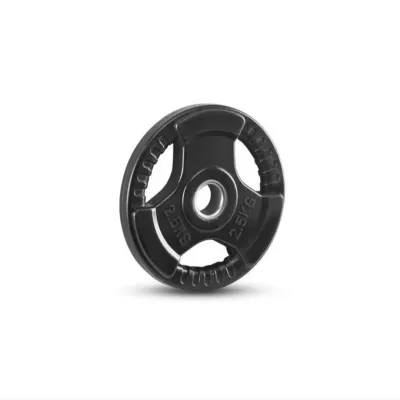
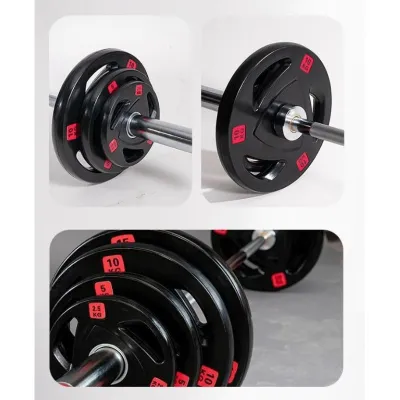
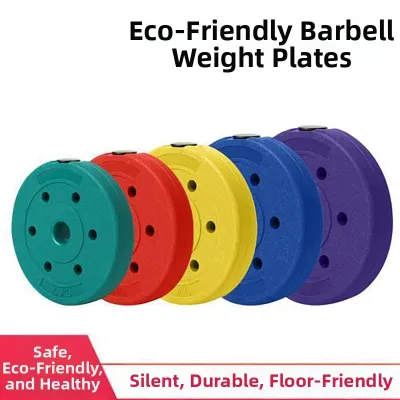
Prices are valid at publication and may change. Please refer to the product page for the latest price.
To achieve a quiet HDB gym, you must combine your choice of barbell plates with a robust flooring system. While bumper plates reduce the initial shock, they should always be used in conjunction with high-density rubber gym tiles. This multi-layered approach ensures that any residual energy not absorbed by the bumper plates is safely dissipated by the flooring before it can penetrate the concrete slab, allowing you to train consistently without causing household friction.
Floor Protection, Space, and Barbell Sleeve Capacity
The physical dimensions of your barbell plates directly affect both the safety of your home’s flooring and the limits of your strength progression. HDB flats typically feature tile, vinyl, or laminate flooring over a concrete screed, all of which are highly susceptible to cracking, denting, or scratching under heavy loads. Dropping a cast iron plate, even from a low height, concentrates immense force onto a very small surface area. This localized pressure can easily shatter ceramic tiles or leave deep indentations in vinyl. Rubber bumper plates, which have a uniform outer diameter across all weight increments, distribute the impact force over a much larger surface area, significantly lowering the risk of localized floor damage.

However, this protective bulk comes with a distinct trade-off in terms of space and barbell sleeve capacity. Because rubber is far less dense than iron, bumper plates must be significantly thicker to achieve the same weight. A standard 20kg bumper plate can be twice as thick as a machined 20kg cast iron plate. This thickness limits the number of plates you can slide onto your barbell’s sleeves. If you are training for heavy powerlifting lifts like the deadlift or squat, you may find that you run out of sleeve space on a standard barbell long before you reach your strength limits.
Cast iron plates, with their slim profiles, allow you to load hundreds of kilograms onto a barbell while keeping the center of mass closer to the middle of the bar, which improves stability during heavy lifts. They also take up far less storage space in your apartment, allowing you to stack them neatly on a compact weight tree. When choosing between the two, you must weigh the physical protection of your HDB floor against your long-term loading requirements and the physical space available in your designated workout area.
Durability, Maintenance, and the "Rubber Smell" Factor
Singapore’s tropical climate, characterized by high humidity and warm temperatures, presents unique maintenance challenges for gym equipment housed in non-air-conditioned HDB rooms. Cast iron plates are highly susceptible to rust when exposed to moisture in the air or sweat from your hands. Over time, untreated iron plates will develop surface rust, which can transfer to your hands, clothing, and barbell sleeves. To prevent this, iron plates require regular maintenance, including wiping them down after workouts and occasionally applying a thin coat of protective oil or rust-inhibiting spray.
Rubber bumper plates do not rust, making them highly resilient against humidity. However, they are subject to their own environmental degradation. Exposure to direct sunlight through apartment windows can cause the rubber to dry out, crack, and degrade over time. Furthermore, cheaper crumb rubber plates can shed small particles or tear at the steel inner ring if dropped repeatedly on rough surfaces. Another major consideration for indoor apartments is the off-gassing odor of new rubber. Many bumper plates, particularly those made from recycled or lower-grade rubber, emit a strong, chemical smell that can quickly overwhelm a small, enclosed HDB bedroom.
To prolong the lifespan of both plate types, establish a simple cleaning and storage routine. Wipe down cast iron plates with a dry microfiber cloth after every session to remove sweat. For bumper plates, use a damp cloth with mild soap to clean off dust and chalk, avoiding harsh chemical cleaners that can break down the rubber compound. Store both types of plates indoors, away from direct sunlight and damp corners, and ensure your workout space is well-ventilated to manage both humidity and any lingering rubber odors.
Price and Value: Budgeting for Your Home Gym Setup
Building an HDB home gym requires a strategic budget allocation, as barbell plates represent one of the most significant upfront costs. When evaluating price, it is helpful to look at the cost per kilogram, though this metric varies widely based on manufacturing quality and materials. Cast iron plates are generally the most cost-effective option. Standard grey iron plates are cast in simple molds and require minimal machining, making them highly affordable for lifters who want to accumulate a large amount of weight on a budget. Machined iron plates, which are calibrated to a tighter weight tolerance and have smoother edges, carry a higher price tag but offer greater precision.
Rubber bumper plates are more expensive to manufacture, resulting in a higher cost per kilogram. Within the bumper plate category, prices vary based on the type of rubber used. Crumb rubber plates, made from recycled tire rubber, are typically the most affordable bumpers; they are highly durable and have a softer bounce, but they are also the thickest and often have the strongest odor. Virgin rubber plates are denser, thinner, and have a much milder smell, but they command a premium price. At the top of the market are competition-grade bumper plates, which feature steel core discs for precise calibration and minimal thickness, though these are rarely necessary for a standard home gym setup.
When planning your budget, consider your training frequency and long-term goals. If you are a beginner or intermediate lifter focusing on slow, controlled movements, standard cast iron plates paired with high-quality flooring mats offer practical value. However, if your training program includes dynamic lifts where dropping the bar is inevitable, investing in a set of mid-range virgin rubber bumper plates is a necessary expense to protect your home, preserve your relationship with your neighbors, and ensure your equipment lasts for years to complete your fitness journey.
The Final Verdict: How to Choose the Right Plates for Your Training
To make the final decision for your HDB home gym, you must match the characteristics of each plate type to your specific training environment and physical constraints. Use the following checklist to guide your purchase:
Choose rubber bumper plates if:
- Your training program consists of Olympic weightlifting, CrossFit-style workouts, or overhead lifts where dropping the barbell is common.
- You live on a middle or upper floor of an HDB block and must minimize structural vibration and impact noise to maintain neighbor relations.
- You have a basic flooring setup and want an extra layer of built-in protection against accidental drops.
Choose cast iron plates if:
- Your workouts focus strictly on powerlifting (squat, bench press, deadlift) or bodybuilding, where weights are controlled throughout the entire range of motion.
- You require heavy loading capacities (typically over 140kg to 180kg) and need thin plates to fit within your barbell's sleeve limits.
- You are working with a tighter budget and want to maximize the amount of weight you can purchase per dollar.
Before finalizing any purchase, verify the structural and physical limits of your space. Check the HDB guidelines regarding floor load limits for residential units to ensure your total equipment weight is distributed safely. Measure your ceiling height to confirm you have adequate clearance for overhead presses, and inspect your existing flooring to determine if you need to install thicker rubber mats before your new barbell plates arrive.
Frequently Asked Questions (FAQ)
Can I mix rubber bumper plates and cast iron plates on the same barbell?
Yes, you can mix rubber bumper plates and cast iron plates on the same barbell, but you must follow specific safety guidelines to prevent damage to your equipment. If you choose to mix them, always place the bumper plates on the inside (closest to the collar) and ensure they have a larger diameter than the cast iron plates. The bumper plates must absorb the brunt of any impact when the barbell is set down. Never drop a mixed barbell from height, as the thinner, unpadded cast iron plates can shift, bend the barbell sleeve, or cause the rubber bumper plates to warp and crack under the unevenly distributed force.
Do I still need rubber floor mats if I buy bumper plates?
Yes, you absolutely still need high-density rubber floor mats even if you use bumper plates. While bumper plates absorb a significant portion of the impact, they do not eliminate the kinetic energy entirely. Dropping a loaded barbell with bumper plates directly onto bare HDB tiles or vinyl flooring can still cause the concrete screed underneath to crack or telegraph damage through the floor. A minimum of 15mm to 20mm of high-density rubber flooring is highly recommended to act as a secondary shock absorber, protecting both your subfloor and the structural integrity of your apartment.
How do I get rid of the strong smell from new rubber bumper plates?
To reduce the strong off-gassing odor of new rubber bumper plates, start by wiping them down thoroughly with a mixture of warm water, mild dish soap, and a small amount of white vinegar. After wiping, place the plates in a well-ventilated area, such as a balcony or service yard, out of direct sunlight, for several days to allow them to air out. Avoid keeping them in a closed, unventilated bedroom immediately after unboxing, as the concentrated fumes can cause headaches or irritation. Over time, the natural off-gassing process will slow down, and the smell will fade to a negligible level.
Community discussion
Share your experience or ask a question. Comments are reviewed before publication.