
Finding the right Merach treadmill for an HDB flat depends on balancing your workout intensity with strict space and noise limits. Since the brand offers everything from ultra-slim walking pads to standard foldable runners, there is no single “best” model for everyone. Instead, the ideal choice relies on matching the machine’s form factor, motor noise, and shock absorption to your specific floor plan, building level, and daily fitness routine. By evaluating how much space you can permanently dedicate to fitness equipment and understanding how sound travels through concrete floors, you can select a model that keeps you active without disrupting your household or your neighbors.
Assessing Your HDB Space and Noise Constraints
Living in a Housing & Development Board (HDB) flat requires a strategic approach to space planning. Unlike landed properties or larger condominiums, HDB apartments feature structural concrete walls and floors that are highly efficient at transmitting impact noise and low-frequency vibrations. Before browsing online marketplaces for a Merach treadmill, you must measure your physical space. This involves mapping out both the active footprint of the machine when in use and its storage footprint when folded. You need to account for at least 1 to 1.5 meters of clear space behind the running deck for safety, as well as half a meter on both sides. Ensure that the placement does not block household shelter doors, bedroom entryways, or common walkways.
Acoustics are equally critical in high-density housing. When you run or walk on a treadmill, your feet strike the deck with a force that can be up to several times your body weight. This kinetic energy travels down through the treadmill frame, into the floor, and directly into the ceiling of the unit below you. This is known as structure-borne noise, and it is often far more disruptive to neighbors than the airborne sound of the treadmill motor itself. If you live on an upper floor, you must plan for noise mitigation from day one.
Products mentioned in this guide





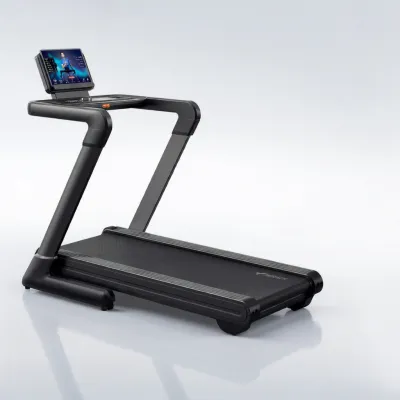
Prices are valid at publication and may change. Please refer to the product page for the latest price.
Finally, consider the electrical layout of your chosen room. Treadmills draw a significant amount of power, especially when starting up or operating at high speeds. You should place the machine close to a dedicated wall outlet rather than relying on daisy-chained extension cords, which can overheat and pose a fire hazard in compact spaces. Ensure the power cable can be routed safely along walls to prevent tripping hazards in multi-purpose living areas or study rooms.
Comparing Merach Treadmill Designs for Compact Spaces
Merach offers several design categories, each tailored to different spatial limits and fitness goals. Understanding these categories helps you narrow down which design matches your HDB layout.

Walking pads and under-desk models represent the most compact category. These machines are designed with an ultra-slim profile, often omitting upright handrails entirely or featuring a single collapsible bar. They are lightweight, frequently weighing under 30 kilograms, and can be easily rolled under a sofa, bed, or stood upright against a wall when not in use. The primary trade-off is performance: walking pads typically have a lower top speed, often capping out around 6 to 8 kilometers per hour. They are built for walking or light jogging and lack the advanced console features, incline options, and wide running belts found on larger machines.
Compact foldable treadmills offer a middle ground for HDB residents who want a more versatile workout. These models feature a sturdier frame with foldable handrails and a console that can fold completely flat against the running deck. This design allows you to jog or run at moderate speeds, often up to 12 or 14 kilometers per hour, while still retaining the ability to store the machine in a closet or against a wall. They provide a more secure feel with handrails for balance, but they are heavier and take up slightly more floor space than basic walking pads.
Standard home treadmills are full-featured machines designed for dedicated workout spaces. They offer wider running belts, higher top speeds, motorized incline settings, and robust console displays. However, they do not fold completely flat; instead, the deck folds upward at an angle, leaving a significant permanent footprint. Because of their heavy frames and powerful motors, they are highly stable but also transmit the most vibration. For most standard HDB flats, a standard home treadmill may feel overwhelming unless you have a spare room dedicated entirely to a home gym.
Critical Specs to Verify for Apartment Use
When comparing different Merach treadmill models, you should look past marketing claims and verify specific technical specifications on the manufacturer’s product sheets.
First, check the motor horsepower (HP) and type. Most home treadmills use Direct Current (DC) motors, which are generally quieter than Alternating Current (AC) motors used in commercial gyms. Look for the continuous horsepower (CHP) rating rather than the peak horsepower. A lower CHP motor (under 1.5 CHP) may struggle and run loudly if you attempt to run on it continuously, as the motor has to work harder to pull the belt under your body weight. For jogging and running, a motor with 2.0 CHP or higher is recommended to ensure smooth, quiet operation.
Second, examine the deck cushioning and shock absorption system. This is the single most important feature for protecting your joints and keeping peace with your downstairs neighbors. Look for models that specify multi-layer running belts, spring dampening, or elastomer shock absorbers. These systems are designed to deform slightly under impact, absorbing the energy of your stride before it can transfer to the concrete floor.
Third, verify the exact folded dimensions and overall weight. Do not rely on visual estimates from product photos. Measure your storage closets, the gap under your bed, or the corner where you plan to store the machine, and compare these measurements directly with the manufacturer’s specifications. Ensure the machine’s weight is manageable for you to move; models with built-in transport wheels are highly recommended for HDB flats where multi-purpose rooms require frequent rearrangement.
Finally, check the maximum user weight capacity. A safe rule of thumb is to choose a treadmill with a weight capacity that exceeds your actual weight by at least 20 kilograms. This safety margin ensures that the motor, belt, and shock absorbers are not operating at their absolute limits, which helps prevent premature wear and reduces operational noise.
Which Design Suits Your Workout Routine?
Selecting the right Merach treadmill is ultimately a matter of matching your daily fitness routine with your spatial reality.
If your primary goal is to increase your daily step count, burn extra calories while working from home, or engage in light cardio, a walking pad is the most logical choice. It fits seamlessly into small HDB bedrooms or study rooms, requires minimal setup, and can be tucked away in seconds. It is also the quietest option, making it ideal for early morning or late-night use when other family members or neighbors are sleeping.
If you are training for a 5K run, enjoy moderate jogging, or require handrails for safety and stability, you should opt for a compact foldable treadmill. This design gives you the speed range necessary for cardiovascular conditioning while still respecting the space constraints of a typical HDB flat. You will need to dedicate a semi-permanent corner of your living room or bedroom for this setup, as folding and unfolding a heavier machine daily can become tedious.
However, if your routine consists of high-speed sprinting, interval training, or heavy incline running, you must recognize the physical limits of compact home equipment. Lightweight foldable treadmills are not built to withstand the intense lateral forces and heavy impacts of sprinting. Attempting high-intensity workouts on a compact machine can cause excessive noise, frame shaking, and rapid wear. In such cases, you may be better served by utilizing outdoor running paths, public gym facilities, or community fitness centers. Additionally, before purchasing any heavy fitness equipment, verify if your specific building management or tenancy agreement has guidelines regarding noise levels or equipment placement.
Setup and Maintenance for Neighbor-Friendly Use
Once you have selected and purchased your Merach treadmill, proper setup and ongoing maintenance are essential to ensure a safe, quiet, and long-lasting exercise experience in your HDB flat.
Always place a high-density, specialized treadmill mat underneath the machine. These mats, typically made of dense rubber or PVC, serve multiple purposes: they absorb high-frequency motor hum, dampen the low-frequency impact of your footsteps, and protect your vinyl, parquet, or tile flooring from scratches and indentation marks. Investing in a high-quality anti-vibration mat, which typically costs around S$30 to S$60, is a small price to pay to maintain good relations with your neighbors downstairs. Ensure the mat is slightly larger than the treadmill’s footprint to catch any stray lubricant or dust.
Maintain safe clearance zones around the machine. Never place the rear of the treadmill directly against a wall, furniture, or glass doors. If you lose your footing, you need a clear path behind the belt to slide off safely without getting pinned against an obstacle. Keep a clear zone of at least one meter behind the deck.
Regular maintenance is key to keeping the treadmill running quietly. Over time, the friction between the running belt and the deck increases, forcing the motor to work harder and generate more noise. Check the manufacturer’s manual for the recommended lubrication schedule, which typically involves applying silicone lubricant under the belt every few months depending on usage. Additionally, monitor the belt tension and alignment; a loose belt can slip and squeak, while an overtightened belt can strain the motor and bearings.
Frequently Asked Questions (FAQ)
Can I use a treadmill on the upper floors of an HDB block?
Yes, you can use a treadmill on upper floors, but you must take active steps to minimize structure-borne noise. HDB flats share concrete slabs, which easily transmit the thud of running footsteps to the units below. To remain a considerate neighbor, always use a thick anti-vibration mat, place the treadmill on a stable, level surface, and avoid running during quiet hours, typically between 10:00 PM and 7:00 AM. If you plan to run at faster speeds, consider a model with advanced shock absorption to further dampen the impact.
Do Merach treadmills require professional assembly?
Many compact Merach models and walking pads are designed for convenience and arrive either fully assembled or requiring minimal setup. Typically, you only need to unbox the unit, unfold the handrails (if applicable), plug in the power cord, and install the safety key. However, you should always consult the specific product manual included with your model to verify if any initial calibration, belt alignment, or lubrication is required before your first workout.
Community discussion
Share your experience or ask a question. Comments are reviewed before publication.